
Litigators in India face the gruelling task of researching case law, precedents, research papers and academic commentaries while building a case. This is usually done manually by scouring databases such as Manupatra and SCC Online and reading lengthy judgments to extract the key legal principles. Junior Associates are usually responsible for legal research and spend 1.5-2 hours on locating cases, statutes and specific regulations.
Generative AI (“GenAI”) is reshaping legal research by reducing the time taken to locate such primary and secondary sources of law. AI-assisted search can perform this task within 5-15 minutes. This does not mean that litigators will be replaced by AI chatbots that are able to perform legal research efficiently. Rather, AI-assisted research will allow them to shift their focus towards applying and analyzing the law.
This article explains and builds insight on the ways in which GenAI is transforming legal research by generating responses within minutes and creating summaries of case law by leveraging retrieval augmented generation (RAG). Furthermore, the article will highlight the opportunity in India’s LegalTech ecosystem to build domain-specific LLMs based on specific practice areas.
What are GenAI Legal Research Tools?
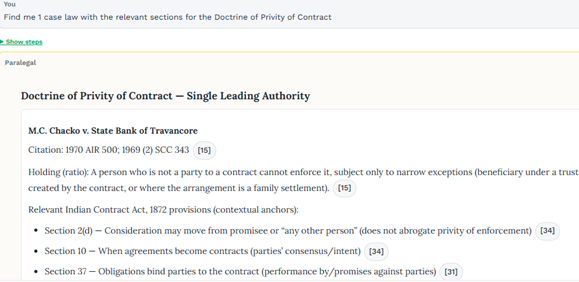
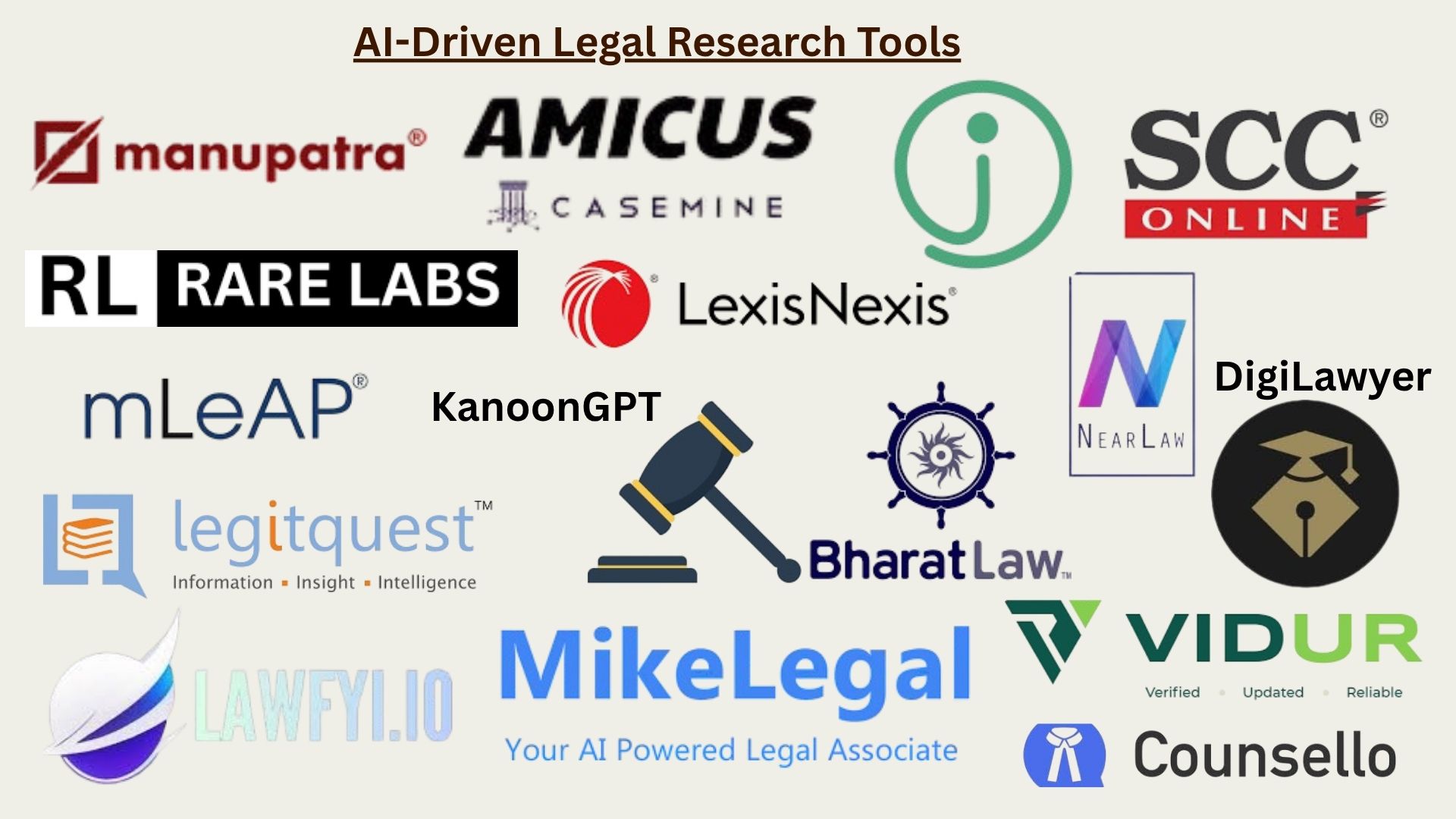
GenAI Legal Research Tools refer to tools such as Casemine, Manupatra, jhana.ai and Kanoon GPT that are able to generate case law summaries and write briefs within seconds. For example, a prompt given to jhana.ai returned an accurate response. The prompt given was to identify a case law and sections relating to the doctrine of privity of contracts.
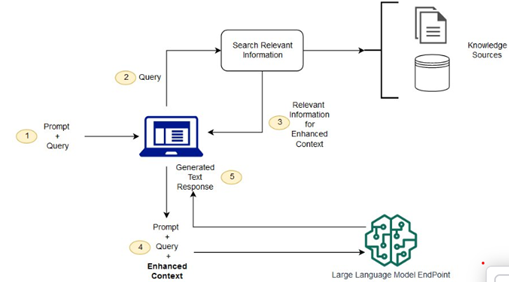
GenAI tools usually rely on a process called retrieval augmented generation (RAG). RAG is a process in which the Large Language Model (LLM) does not return a response only based on the data it was trained on but accesses an external database.
For example, if we give a prompt to jhana.ai to explain the key provisions of the DPDP Act, the LLM will understand the query and the prompt first. Then it will tap into a database such as the statute and cases and combine it with the query and the prompt to generate a response. RAG is an extra step added to the tool to contextualize the prompt. The flowchart below explains RAG simply.
How GenAI is Redefining Legal Research Workflows
Before we understand how GenAI is redefining legal research workflows it would be helpful to track the evolution of legal research. Legal research is currently undergoing its 3rd phase of evolution. The 1st phase involved associates using books, statutes, commentaries and physical copies of judgement to cull out principles and arguments. This would lead to manual labor, printing expenses and incorrect citations due to the vast amounts of texts an associate would have to research from.
The 2nd phase involved the digitization of judgements, statutes, commentaries through databases such as SCC, LexisNexis and Manupatra where filters such as type of court, year, jurisdiction and area of law could be applied manually to identify case laws, precedents and sections of statutes. This created efficiency and reduced manual errors but associates still have to spend a considerable time on legal research.
The 3rd phase is ongoing with GenAI transforming legal research workflows by completing tasks in minutes and not hours.
There are mainly 4 ways in which GenAI is changing legal research workflows:
- Prompt Engineering as a skill: Lawyers in India are forced to memorize case laws and are taught to read and analyze 100-page judgements. However, with the advent of GenAI litigators have to develop the skill of prompt engineering. Prompt engineering refers to the skills of learning how to write a prompt that generates an accurate answer. GenAI legal research tools do not generate answers by themselves and thus still require lawyers to write effective prompts to provide such tools with their requirements and context.
- Higher-Efficiency: Litigators in India do not need to spend time scouring databases by applying filters manually to locate case law and precedents. This can be done in minutes with the help of GenAI tools that generate summaries of case law and write AI-generated briefs. Litigators can focus on their efforts on building a trial strategy and the application of the law to the facts. AI-assisted legal research can reduce the time taken for a litigation matter from 17-28 hours to just 3-5.5 hours.
- Reduced Margin of Error: In the 2nd phase of legal research though paper-based workflows reduced associates had to still scour databases to find the correct citation and legal principles in a case. This would often lead to errors such as incorrect citations and identifying inapplicable legal principles from a case. However, with GenAI tools cross-verification is still important but cross-verification with multiple databases is no longer a necessity.
- Billable Model: GenAI tools will result in cost savings for litigators in India and thus clients expect the benefit of such tools to carry on to them. However, litigators will adopt a model depending on the kind of legal research they would require. For example, if a client requires due diligence, then a billable model would be adopted due to vast amount of research that has to be done by sifting through documents. However, if the client hires a litigator with the purpose of only legal research, then it would be a fixed-fee structure.
The Concern around GenAI Legal Research Tools
The primary concern with respect to GenAI legal research tools is the accuracy of the generated responses. The cost of such inaccuracies can be extremely high, especially in legal services. There have been documented instances in the law where the tool has hallucinated i.e. dreamt up fake cases with fake citations.
For example, a tax tribunal order issued by the Bengaluru Income Tax Appellate Tribunal (ITAT) referred to three SC judgements and one Madras HC judgement all of which did not exist. In the US, a bankruptcy lawyer was fined by the judge for citing 4 cases that did not exist as the lawyer did not verify the output.
The usage of GenAI legal research has to ensure human oversight to verify the output’s accuracy by cross-checking the citations and cases from a database. The accuracy of such tools is improved by processes such as fine-tuning, RAG and training the model from a variety of sources.
The Indian opportunity to build Domain-Specific LLMs
Litigators in India practice in a variety of areas such as Capital Markets, M&A, Banking and Finance, Anti-trust and Family Law. Generic tools such as ChatGPT and Gemini are trained on large datasets and do not specialize on particular areas.
India’s next set of GenAI legal research tools will be specialized in different areas. These domain-specific LLMs would be trained on narrower datasets producing accurate answers and fewer hallucinations in comparison with other research tools. Domain-specific LLMs would be trained on the firm’s internal knowledge management.
For example, if an LLM is being built for competition law then it would be trained on the litigator’s previous contracts, briefs, research notes and petition drafts to customize the LLM to the lawyer’s needs and provide a better context while generating an output.
Conclusion
GenAI legal research tools are transforming workflows for lawyers by allowing them to focus on their true skillset of applying the law. Furthermore, GenAI is creating prompt engineering as a new skill for lawyers to develop. This coupled with higher efficiency and a reduced margin of error creates an attractive value proposition for the adoption of such tools.
The adoption of GenAI in legal research creates opportunities for the next generation of LegalTech startups to build domain-specific LLMs. GenAI tools in legal services will not only create opportunities for builders in India’s LegalTech ecosystem but allow future lawyers to focus on their real skillsets. GenAI’s revolution in law calls for law firms in India to experiment and build with GenAI or risk being left behind.
Sources: Thomas Reuters, MEDIANAMA, jhana.ai, Times of India, Artificial Lawyer, American Bar Association (ABA), Livelaw, Future of legal work (Deloitte), North Penn Now and Dream Legal
Authored by: Harshith Viswanath
Also read: Research to Redlining: How AI Copilots are redefining the lawyer’s role