
The Indian judiciary is suffering from a backlog of 4.9 crore cases with 13 lakh cases still in the pre-litigation stage. The judiciary is plagued by inefficiencies such as procedural delays, low judge to population ratio, legal complexity of cases and absence of prescribed timelines for case disposals. Artificial Intelligence (“AI”) has entered the courtrooms with a familiar promise of speed, efficiency and relief to reduce the backlog.
AI tools promise to automate case management, translation, scheduling of hearings, filing court documents and assist judges in decision-making through predictive analytics. This would give judges more time to their responsibility of adjudicating disputes. However, though AI tools offer speed and efficiency the core reason for the backlog remains unaddressed. India has 15 judges per 10 lakh people which is well below the recommended 50 judges per 10 lakh people by the 1987 law commission.
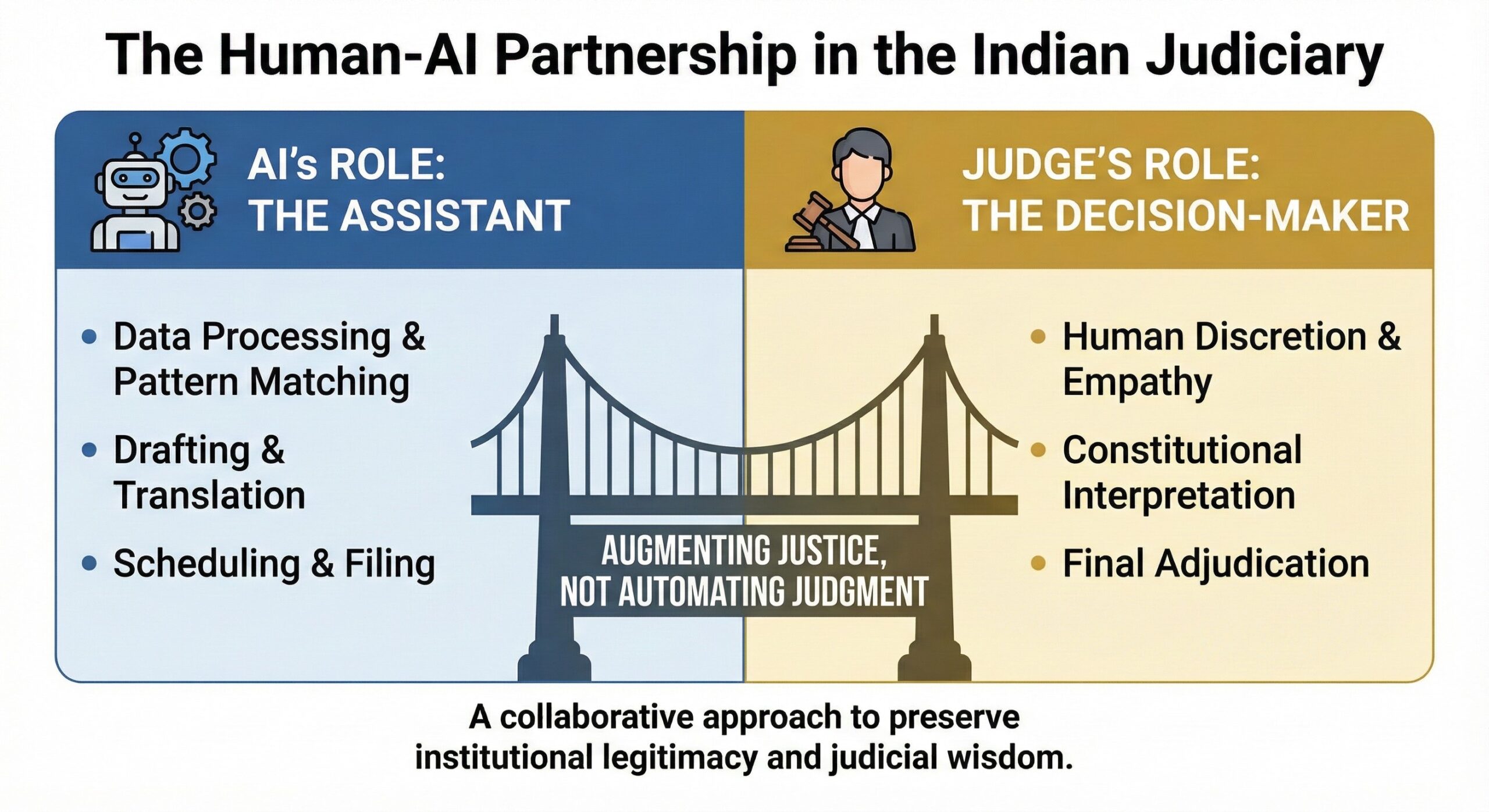
The central thesis of this article is that AI tools would only be used in the capacity of assistants and not in a decision-making capacity. This decision by the Indian judiciary is not only one that is made in the interests of efficiency but also an institutional choice to preserve legitimacy, accountability and judicial discretion. Furthermore, the article analyzes the regulation of AI in the judiciary with a focus on the recent guidelines issued by the Kerela High Court.
AI in the Indian Judiciary
AI in the judiciary has the potential to transform case management, legal research, translation of documents, hearing appointments and filing court documents. There are 3 key technologies that are being used in the Indian judiciary:
- Machine Learning (“ML”) – ML is defined as a subset of AI that uses pattern matching based on its training data to make inferences on new data. This allows LLMs to make decisions without explicit instructions. ML is usually used to build tools for tasks like legal research, drafting and predictive analytics.
- Natural Language Processing (“NLP”) – NLP is a subset of AI that uses ML to allow LLM models to understand and communicate in human language. NLP allows lawyers to prompt an LLM model for extracting case law, assisting in drafting and summarizing jurisprudence.
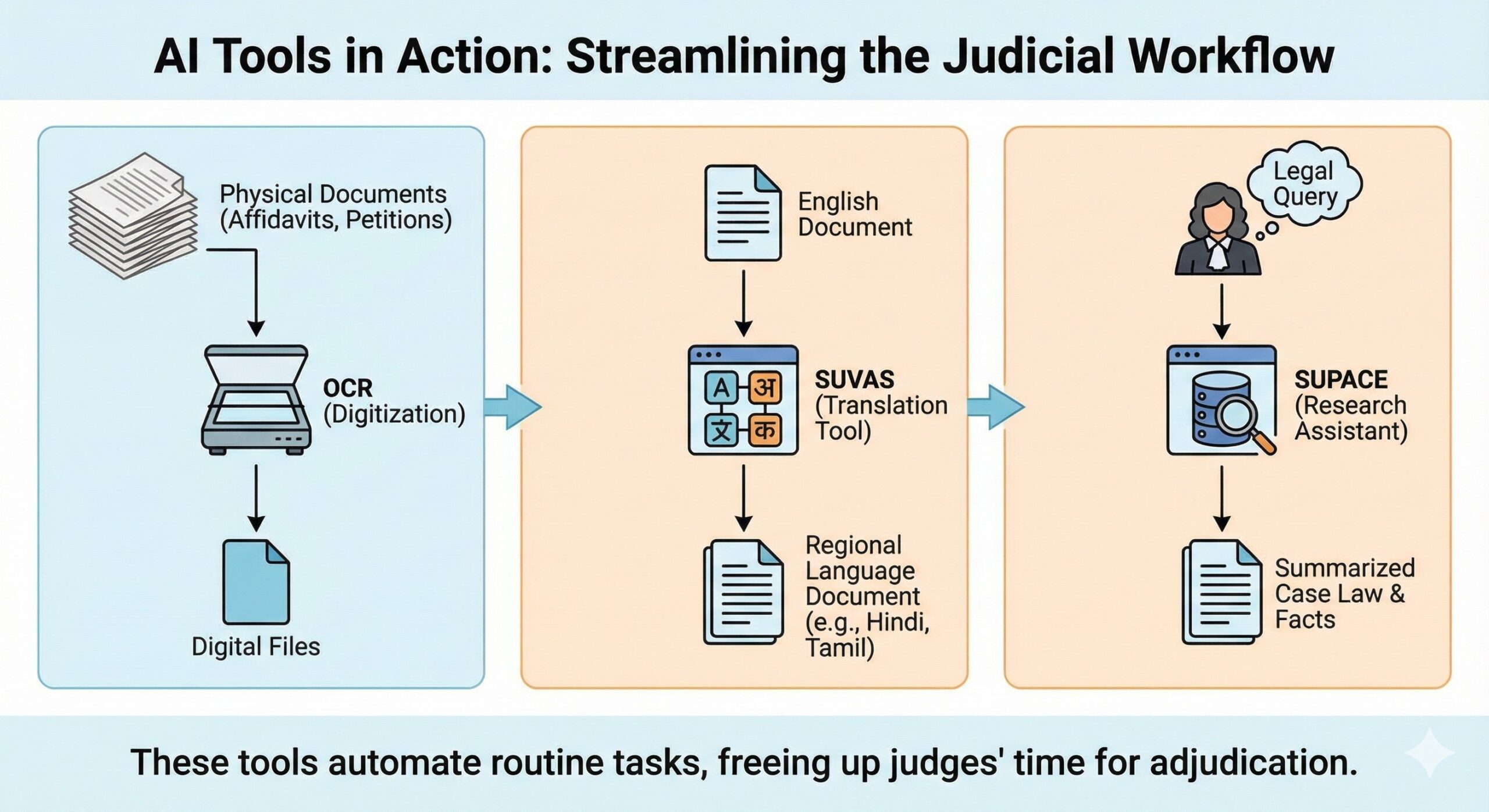
- Optical Character Recognition (“OCR”) – OCR allows the digitization of physical documents. In India, courts often have to translate document such as affidavits, bail petitions and witness transcripts into English. OCR technology is used for digitization and translation documents from district courts.
AI is being integrated into the judiciary as part of the e-courts project’s Phase III. The Indian government has allocated a budget of Rs 7,210 crores with Rs 53.57 crores earmarked for integration of future technological advancements such as AI and Blockchain across high courts up to 2027.
The Supreme Court of India has already started utilizing tools such as:
- SUVAS (Supreme Court Vidhik Anuvaad Software) – This tool automates translating of English documents into regional and vernacular languages.
- SUPACE (Supreme Court Portal for Assistance in Court’s Efficiency) – This tool assists judges in cases analysis and legal research freeing up time for judges to make decisions.
AI-driven translation tools have translated over 31,000 Supreme Court judgements into 16 regional languages including Hindi, Marathi, Tamil and Kannada. Furthermore, High Courts across India have collectively translated 4,983 judgements using such tools. Notably, none of these tools have been used in an adjudicatory capacity.
AI as a Judicial Assistant
AI tools have to be used to streamline routine tasks such as translation, case research, e-filings and drafting judgements. These tools have to be used purely for digitizing and automating clerical work. AI cannot be used as a substitute for judicial reasoning as the law is an endeavor that requires human intuition and discretion.
Justice Manmohan in his address at the “Transforming Justice Delivery System with AI & Technology “conference emphasized that AI should assist judges in making decisions and not creating automated courts based on algorithms. Justice Manmohan called judging an “artful exercise of human wisdom”. This means that technology cannot replicate sensitivity to emotion and trauma, ability to detect coercion and balance constitutional values with societal impact.
The judiciary’s limitation on AI use to streamline routine tasks is not only in the interests of justice but also to preserve its institutional legitimacy. The Indian judiciary’s cautious approach to AI reflects a classic case of normative institutional isomorphism which is homogenization driven by professional standards. The legal services industry is adopting AI tools to automate routine and manual work such as drafting, research, contract review and translation of documents.
Judges, Law Firms, In-house and Altrenative Legal Service Providers (ALSPs) share a common professional logic that legal reasoning must be human. Otherwise, it could lead to errors and responsibility would not be traceable as AI agents cannot be held liable.
The Risks Courts Cannot Afford
There are 3 risks that arise with integrating AI into the Indian judiciary:
- Algorithmic Bias – AI tools should not reinforce existing gender, class and caste-based inequalities. The reinforcement of such biases is very much possible as these tools generate answers based on pattern-matching. These tools are trained on data and this might to lead to past biases becoming embedded in the system. In US, the Correctional Offender Management Profiling for Alternative Sanctions (COMPAS) tool is used to evaluate the risk of recidivism. A study by the ProPublica of 7,000 defendants highlights how the COMPAS algorithms is more likely to flag black defendants than white defendants for the risk of recidivism. This is an example of algorithmic bias and institutionalizes discrimination.
- Transparency – These tools often are called “black boxes” as even developers do not understand the method used by LLMs to generate responses. Human judges are required to reason out order and provide evidence for their reasoning. However, AI systems can generate orders without proper reasoning which would weaken the ability of litigants to challenge outcomes.
- Erosion of Judicial Reasoning – Beyond opacity and bias, there exists the risk of the role of AI systems shifting from clerks to decision-makers that not only assist but are able conduct and evolve cognitive legal reasoning. Judicial reasoning cannot be offloaded to AI systems. This can be harmful to India’s justice system as these systems can miss subtle nuances like empathy, coercion and societal impact that require perception and intuition.
The Kerala High Court guidelines are a step forward in this regard to mitigate such risks. These guidelines are centered around the core philosophy of AI being used in an assistive function and not in a decision-making capacity. The guidelines specify different aspects to minimize such risks such as allowing usage of approved tools, maintaining audit trails, human verification and preventing confidential data usage.
Furthermore, in Jaswinder Singh vs State of Punjab the court used ChatGPT to summarize and understand bail jurisprudence. The court clarified that these AI-generated insights were supplemental to understand the law and not determinative of the decision. With AI governance guidelines rooted in principles such as transparency, bias, ethics and accountability the legislative proposals are moving in the right direction.
Conclusion
Artificial intelligence offers the Indian judiciary valuable tools to improve efficiency, accessibility and administrative functioning. However, its adoption has been deliberately confined to assistive roles rather than adjudicatory functions. This restraint reflects a conscious institutional choice to preserve judicial discretion and align with the professional standards in legal services.
The judiciary’s cautious approach is reinforced by safeguards such as human verification, auditability, and limits on permissible use. At the same time the judiciary acknowledges the risks of algorithmic bias, opacity, and erosion of judicial reasoning. The adoption of AI by the judiciary viewed through the lens of normative institutional isomorphism reflects a trend in the legal services to keep legal reasoning human.
Ultimately, AI’s role in the Indian judiciary is not to replace judges, but to support them. By augmenting justice without automating judgment, Indian courts demonstrate how technological innovation can be balanced with constitutional values and institutional integrity.
Authored by: Harshith Viswanath
Sources: PIB, Kerala High Court guidelines, ProPublica, Legasis, LawJournals.net “Artificial Intelligence (AI) in Indian Courts: Transformations, Challenges and Future Prospects”, Times of India, Analytics India Magazine, Law Advice, Great Lakes India Review of Management, Technology & Research “Can Artificial Intelligence Revolutionise India’s Judiciary System?”, International Journal for Multi-disciplinary research “Incorporating Artificial Intelligence into India’s Judicial and Law Enforcement Systems”, Cybermithra, “The Iron Cage Revisited: Institutional Isomorphism and Collective Rationality in Organizational Fields” by Paul J. DiMaggio and Walter W. Powell
Also read: A new lifeline emerges for MSMEs