
MSMEs form the lifeblood of the Indian economy. India has 5.93 crore MSMEs employing 25 crore people with exports worth Rs 12.39 lakh crores. MSMEs contribute to 45.79% of the total export-related output of the GDP. Despite powering nearly 50% of India’s exports, MSMEs remain underserved participants in the justice system due to high litigation costs, fewer lawyers offering such services and lack of legal awareness.
AI Chatbots, Marketplaces and ODR are resolving these pain points for MSMEs. AI Chatbots are creating legal awareness by providing instant answers to queries. Marketplaces are providing instant access to lawyers while ODR platforms are cutting down costs and timelines for MSMEs. These services are not only solving pain points for MSMEs but are also expanding the LegalTech market as such enterprises are an underrepresented vertical.
The article analyzes the development of AI Chatbots, Marketplaces and ODR becoming legal lifelines for MSMEs and the challenges that small enterprises face while adopting such technology. Furthermore, as technology continues to democratize legal services two transformative opportunities arise in the LegalTech sector: (1) AI-Native Law Firms and (2) Third-Party Litigation Funding.
MSMEs vs Large Corporate Companies
Before we understand the pain points that AI Chatbots, Marketplaces and ODR are solving for MSMEs there needs to be an understanding of the difference between MSMEs and corporate companies.
MSMEs refer to Micro, Small and Medium Enterprises that are classified on the basis of the investment limit and turnover. MSMEs are usually small businesses like textile producers, beauty parlours, electronic component manufacturers, dairy parlours and call centres.
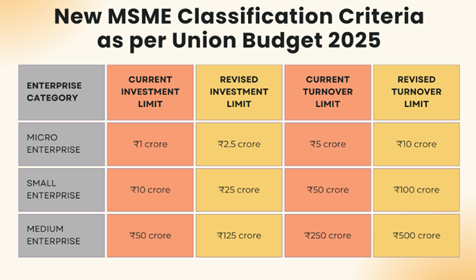
From the classification criteria of the Union Budget 2025-2026 we can see that MSMEs are usually small businesses. Large corporate companies usually have an in-house team that handles day-to-day compliance while retaining top law firms for transactional advisory and dispute resolution. MSMEs operate with neither of these legal services. MSMEs cannot pay millions of dollars for legal services like large corporates.
Legal services for MSMEs have to be cost-effective. This is the reason why BigLaw does not provide services to such enterprises (low margins) leading to MSMEs being an underrepresented vertical that lacks access to commercial justice.
Furthermore, small businesses are not located in urban centers. These businesses are located in rural areas where accessing lawyers is difficult due to lower digital connectivity. Traditionally MSMEs have been excluded from the purview of legal services due to the reasons highlighted above.
The MSME Problem Stack
- High Litigation Costs
MSMEs usually face high litigation costs. According to studies done by GAME and Duns & Bradstreet MSMEs pay a whopping Rs 1.6 lakh crores for legal issues annually. These litigation costs are incurred due to payment disputes.
Rs 10.7 lakh crore worth of revenue to MSMEs is locked up in the economy due to such disputes. In a survey conducted by SIDBI, 7% of the respondents highlighted that delayed payments were an issue. The risk of such payment disputes is amplified in the trading sector with 15% of the respondents viewing such disputes as a hurdle.
- Fewer Lawyers
MSMEs are usually located in rural areas where lawyers do not offer such services to MSMEs. This stems from the perception of lawyers that MSMEs are small businesses that are low-paying, unstructured and not worth the long-term investment.
However, modern day MSMEs are looking for forward-thinking legal partnerships. MSMEs require legal services for a variety of purposes such as vendor contracts, IP, fundraising and employment as well. The underrepresentation of MSMEs in legal services stems from the perception of lawyers as well.
- Lack of legal awareness
MSMEs often experience a knowledge gap as the owners and operators have to be informed about different areas of law such as contracts, employment, tax compliance and IP. Justice Bobde of the Supreme Court said that only 0.5% India’s population receives legal aid while more than 80% are eligible for it.
8-10% manufacturing SMEs face issues in securing business licenses and permits with 15% of such SMEs reporting tax compliance as an issue. MSMEs need to be formalized as with more than 90% of India’s MSMEs belonging to the informal sector. Legal illiteracy acts as a barrier to long-term competitiveness, formalization, compliance and survival of the business.
These structural barriers for MSMEs to access legal services create the perfect condition for AI Chatbots, Marketplaces and ODR platforms to emerge as scalable alternative.
The Legal Lifelines: AI Chatbots, Marketplaces and ODR platforms
The MSME problem stack creates opportunities for LegalTech innovation. Each of the friction points faced by MSMEs corresponds directly to an area where technology can create transformative value.
- AI Chatbots
The knowledge gap among MSME owners creates an opportunity. These chatbots act as the first-line of assistants that can answer basic queries and break down complex vendor contracts into simple and actionable insights.
MSME owners no longer have to rely on google searches which usually leads to confusion because of multiple websites. Furthermore, MSME owners can achieve legal literacy which would lead to a comprehensive understanding of the business’s legal needs.
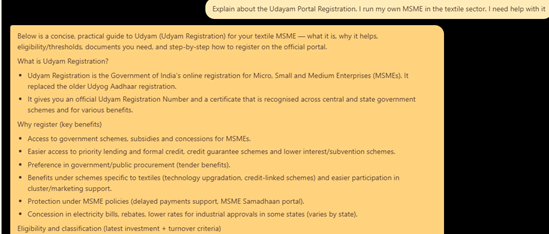
For example, NyayGuru is example of such an AI chatbot. The prompt given to NyayGuru was to explain the Udyam portal registration based on a fictional scenario of owning a textile MSME. The chatbot gave a detailed and practical explanation of the various elements such as eligibility, necessity and documents required. (Source: NyayGuru)
In China, LLM-powered chatbots were launched in 2023 and deployed in 14,000 villages in the Yunnan province conducting 620,000 free legal consultations in the initial few months alone. These chatbots are able to act like lawyers by asking more questions based on the prompt.
However, these chatbots can be used to obtain answers to routine legal questions and should never be treated as legal advice. The aim of these AI Chatbots would be to educate the MSME owner about their rights and remedies. Based on upon this they can approach a lawyer who would best suit their needs.
- Marketplaces For Lawyers
Lawyers usually operate in urban centers while small businesses are set up in rural areas. This leads to a lack of access to legal services. However, marketplace startups for lawyers such as Vakilsearch, MyAdvo, Law Wagon, LegalKart and Law Rato offer instant access to lawyers. These startups are focusing on servicing specific segments which are MSMEs and Startups.
These enterprises do not face the issue of accessibility as consultation takes place completely online. These marketplaces offer lawyers for a wide range of services such as IP, Tax, Business Registration and Contracts.
These consultations can be accessed by anyone with a mobile phone. In rural areas 96.8% of people in the age group of 15-29 used mobile phones at least once during the last three months. With growing digital penetration accessibility will improve as well.
- ODR Platforms
Payment Disputes are the main kind of disputes that MSMEs face. MSMEs need such disputes to be resolved quickly and cost-efficiently as these enterprises require cash flow to survive and expand. As the saying “cash is king” goes, these enterprises need continuous cash flow in order to make investments in plant and machinery, hire workers and begin production.
These disputes can be resolved through ODR. Courts usually take 1,445 days to resolve a dispute. This is because of the backlog faced by the judiciary. India’s commercial tribunals face a backlog of 360,000+ cases which is costing the economy 7.5%. Furthermore, contract-intensive industries spend Rs 3.12 lakh crores annually.
ODR platforms like Presolv360 reduce the time to resolve a dispute to 45-90 days and reduces the cost of dispute resolution due to costs such as paper filings, travel and lawyer fees being eliminated.
The Opportunity For AI-Native Law Firms and Third-Party Litigation Funding
The democratization of legal services to India’s MSME sector present two new opportunities to build in the LegalTech space: (1) AI-Native Law Firms and (2) Third-Party Litigation Funding.
- AI-Native Law Firms
AI-Native Law Firms are those firms which adopt AI not just to automate their work but as part of their core infrastructure. These firms would use leaner teams and would provide services such as contract review, vendor compliance and due diligence. The fee for such services would be fixed and client’s requirements would be completed within a few days.
However, this does not mean that lawyers would not be required. Lawyers would still be required to verify the AI’s output and pinpoint strategic issues with the client’s situation. Furthermore, lawyers are increasingly turning to MSMEs as though margins are low, a small business that stays for a lengthy period of time (Eg 6-7 years) would provide higher customer-lifetime value.
The advantage for such firms would be that BigLaw would not be able to compete with them due to low margins as these law firms deal with clients that require high-value advisory services. AI-Native Law Firms would be able to capture value due to cost-reduction by automation.
- Third-Party Litigation Funding
MSMEs usually lack the funding for legal proceedings which includes ADR and ODR. Bank loans and NBFCs usually provide loans for such proceedings but at high-interest rates. This makes the loan expensive and puts pressure on the cash flows of such enterprises.
Third-Party Litigation Funding offers an alternative and payment disputes are attractive to such funds due to shorter exit timelines. These disputes offer small ticket sizes and allow MSMEs to recover payments quickly. Litigation funds in India include Legal Fund, FightRight and LitiCap Partners.
Conclusion
MSMEs are gaining access to commercial justice thereby unlocking value for such enterprises. These enterprises no longer have to pay high litigation or depend on physical consultation of lawyers. AI Chatbots, Marketplaces and ODR are emerging not just as conveniences but as parallel infrastructures that are designed for scale, speed and affordability.
These tools are reshaping the ways in which MSMEs access competent legal help, understand their rights and resolve disputes that directly affect their survival. For a sector that is shaped by continuous cash flow access to reliable and affordable legal support is a necessity.
The next-frontier of innovation for MSMEs lies in building AI-Native Law Firms and Third-Party Litigation Funding that unlocks justice for such enterprises. As India continues to formalize its MSME sector technology will form the backbone of an inclusive and equitable commercial justice system. For MSMEs, the question is no longer if they can afford legal counsel, but whether they can afford to ignore the tools that provide it.
Authored by: Harshith Viswanath
Sources: PIB, Yale Law Review, Dispute Resolution Online (Handbook), Business Standard, NyayGuru, Times of India, International Labour Organization, SIDBI report “Understanding Indian MSME Sector: Progress and Challenges”, IndiaAI, Analytics India Magazine, Bar & Bench, Financial Express, Law Crust and NITI Aayog Report “Enhancing MSMEs competitiveness in India”
Also read: The AI-Native Legal Research stack: The Rise of Generative AI in Legal Research